“199 Tips”: 60 days later
Published Friday, November 10, 2006 by Retaguardia Films | E-mail this post

by Andrés Waissbluth
Two months have passed since the end of filming “199 Tips To Be Happy” and it seems like a good time to look back on it. It took almost 5 years of work to be able to film the story “Noticias de Milo”, by Marcelo Leonart. That was the starting point on the path of which, as we moved forward, I gave myself more and more possibilities to take more risks, and to make a movie different from everything I’ve done so far.
Starting with a published story was already a novelty. I have always filmed original ideas of my own. By the end of it, there was nothing and everything left of the story. My course in adapting literature to film was to respect the idea and to intervene in the form, distorting it to such an extent that by the end, it had changed the idea. This is how it went from being a minimal, voyeuristic concept to a mental, complex film. It’s also how I went from the obvious themes of the story: lies and hidden incest, mimicry and latent homosexuality, to one that outlasts the others: the survival of the couple. Even though neither partner is what he or she wanted to have been in the past. Once it reached this point, the self-help perspective became a natural element in cinematographic construction. The tips can seem absurd; however, they end up helping Tomás in spite of himself, in his process of maturation. And this seems to be the best tip for his happiness: growth. To accept that he isn’t the same person he dreamed of being when he was 20 years old.
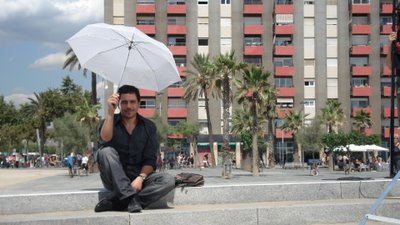
Filming in another country caused this experience to be a challenge from the start, and not only because of the difficulties with production and the creative obstacles that this implies. The most important challenge was that for all of us it was, literally, a voyage into the unknown. This had the unexpected effect of everything becoming sensualized. With suffocating temperatures and faces of multiple colors, Barcelona gave me the sensation of being an eroticized city under its layer of supposed elegance and sobriety. Going even further than the end-of-shooting stories, this was a big contribution to the film. It made the whole environment strange. The film has only one sex scene, at the end; however, the sexual tension is always being breathed in. That tension gave me the possibility to go a step farther and keep taking risks, arriving at the best sex scene I have ever filmed. It’s exciting. It closed a chapter. After doing short and feature films on the subject, I don’t want to film any more sex, at least not for a while.

I think we were lucky. The crew that worked on the film, which is the crew that’s always worked with us for the last few years, is living a great creative moment. They combine experience and talent to perfection. Sebastián Muñoz in art direction, Inti Briones in photography, Bruno Bettati in production, accompanied long-distance by Crisis. Waldo Salgado, by my side, clearing the way ahead. The Chilean-Catalonian grafting of Manuel Robles. Cristian Petit-Laurent and Cristian Burgos. Michelle Bossy. Paco Toledo. They all have many feature films under their belt, but they’re still young, with a fresh, restless gaze. Every first cut shot I’m finishing up now is a testament to that fact. And the actors, too. Pablo Macaya playing the part of his life, in the most literal sense. Tamara Garea putting forth a touch of distinction and nostalgia, and Andrea García Huidobro delivering a potential and ambiguity that puts you on edge. Added to them is Alex Brendemühl, a Catalonian actor or German descent, as weird as he is adorable. They’re all fantastic.

This human combination is what, in spite of the difficulties unique to any filming, protected me and helped me take the steps I wanted to take: to begin to allow myself more as a director. It wasn’t a matter of being able to take my hands off, but rather of being able to free up my mind. To let myself be carried away by imagination. To defeat fears. To allow myself things I had thought were impossible or unreachable. Breaking the timeline in “Los Debutantes” was a first step. In “199 Tips To Be Happy” I allowed myself certain extravagances appropriate for the mental state of the project. It was one step further. Still timid, perhaps. One thing is certain: the more risks we took, the more fun we had. We felt happy filming. That was what I learned, the tip I’m just now coming to discover. That is my best memory of August in Barcelona.
Andrés Waissbluth
Director, “199 Tips To Be Happy”

